Skip to content

PDI Logo

  • About PDI
    • About Us
    • History
    • Vision and Mission
    • People
    • Contact
  • Centers
    • CISS
    • CSPL
    • CSEU
    • KACDC
    • CRCEA
    • CSC
    • CSID
  • Activities
    • Soodang/Woodang Colloquium
    • Woodang Academy
    • Jiam Research Workshop
    • Civic Education
    • Events
    • Pol in Love
  • Publications
    • Journal Article
    • Book
    • Working Paper
  • Journal
    • Peace & Democracy
    • About Peace Studies
    • Editorial Board
    • Archive
    • For Contributors
    • Submission
  • News
    • Notice
    • Upcoming Events
    • Press Release
    • Newsletter
Korean English
KOR ENG
  • About PDI
    • About Us
    • History
    • Vision and Mission
    • People
    • Contact
  • Centers
    • CISS
    • CSPL
    • CSEU
    • KACDC
    • CRCEA
    • CSC
    • CSID
  • Activities
    • Soodang/Woodang Colloquium
    • Woodang Academy
    • Jiam Research Workshop
    • Civic Education
    • Events
    • Pol in Love
  • Publications
    • Journal Article
    • Book
    • Working Paper
  • Journal
    • Peace & Democracy
    • About Peace Studies
    • Editorial Board
    • Archive
    • For Contributors
    • Submission
  • News
    • Notice
    • Upcoming Events
    • Press Release
    • Newsletter

Activities

  • Soodang/Woodang Colloquium
  • Woodang Academy
  • Jiam Research Workshop
  • Civic Education
  • Events
  • Pol in Love

Civic Education

[Citizen College Season 5] #3 US-China Strategic Competition and Global Security

2021.10.25

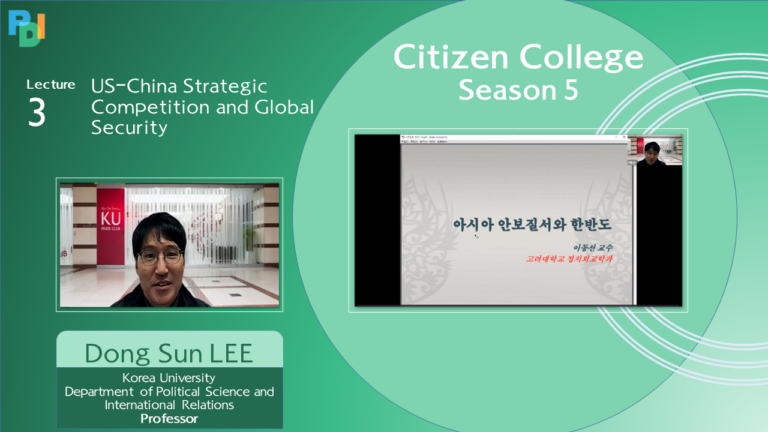
On October 22, 2021 (Fri), the third lecture of “Citizens and the World in the Corona Pandemic Era,” a civic education jointly organized by Seongbuk-gu Office and Korea University’s Peace & Democracy Institute, was conducted using ZOOM. The third lecture was given by Professor Dong Sun Lee of Korea University’s Peace & Democracy Institute.  

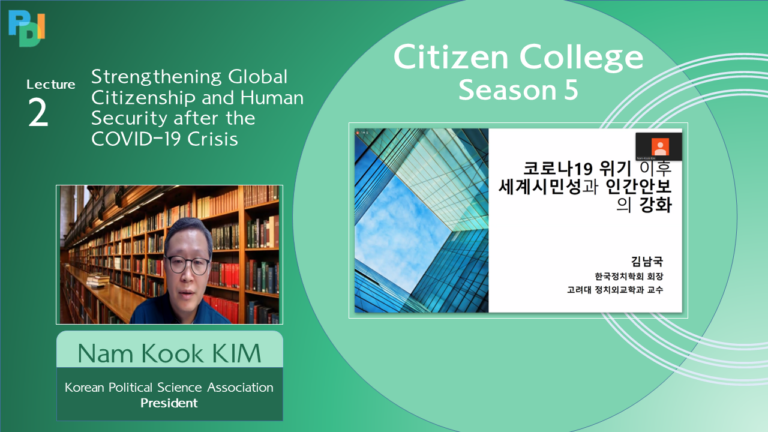
[Citizen College Season 5] #2 Strengthening Global Citizenship and Human Security After the COVID-19 Crisis

2021.10.17

On October 15, 2021 (Fri), the second lecture of “Citizens and the World in the Corona Pandemic Era,” a civic education jointly organized by Seongbuk-gu Office and Korea University’s Peace & Democracy Institute, was conducted using ZOOM. The second lecture was given by Professor Nam Kook Kim, the director of Korean Political Science Association.

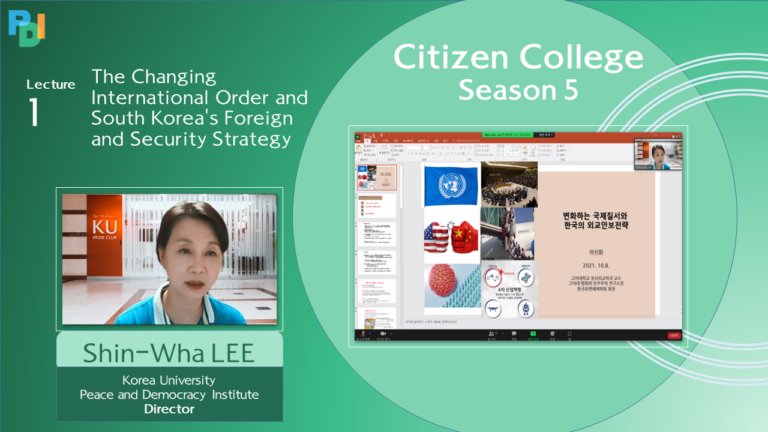
[Citizen College Season 5] #1 The Changing International Order & Korea’s Foreign and Security Strategy

2021.10.12

On October 8, 2021 (Fri), the first lecture of “Citizens and the World in the Corona Pandemic Era,” a civic education jointly organized by Seongbuk-gu Office and Korea University’s Peace & Democracy Institute, was conducted using ZOOM. The first lecture was given by Professor Shin Wha Lee, the director of Korea University’s Peace & Democracy Institute.

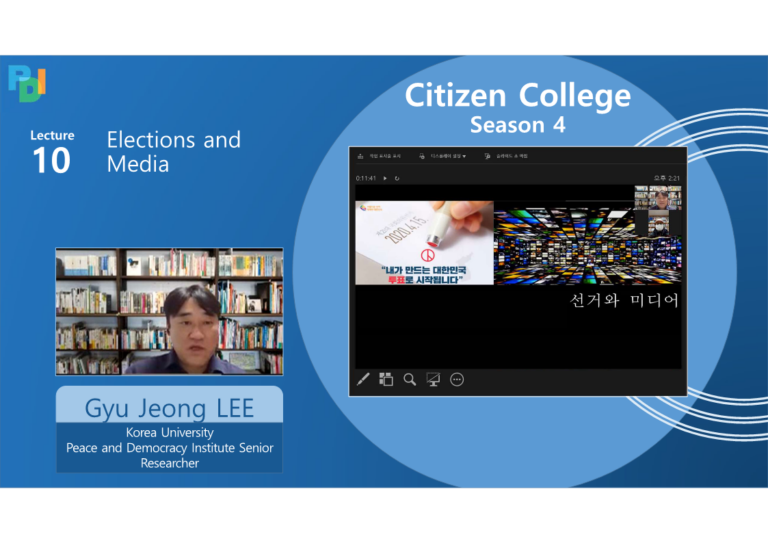
[Citizen College Season 4] #10 Elections and Media

2020.11.13

On November 13, 2020, the tenth lecture of Citizen College Season 4 < Citizen and Participation: How do citizens become owner of politics? > , co-hosted by the Seongbuk-gu Office and the Peace and Democracy Institute, was conducted using ZOOM. The tenth lecture was given by Dr. Gyu Jeong LEE, Senior Researcher at the Peace and Democracy Institute. The lecture, titled “Elections and Media,” was a time to learn about the impact of media on elections, especially the recent fake news issues. The images and emphasis of the candidates shown by the media have influenced voters who watch the media in various forms in actual elections. And the positive influence of the media on these elections has recently begun to be misused in the form of several fake news. In particular, fake news has distorted voter’s voting information, intensified factional strife, undermined the overall media credibility of Korean society and⋯

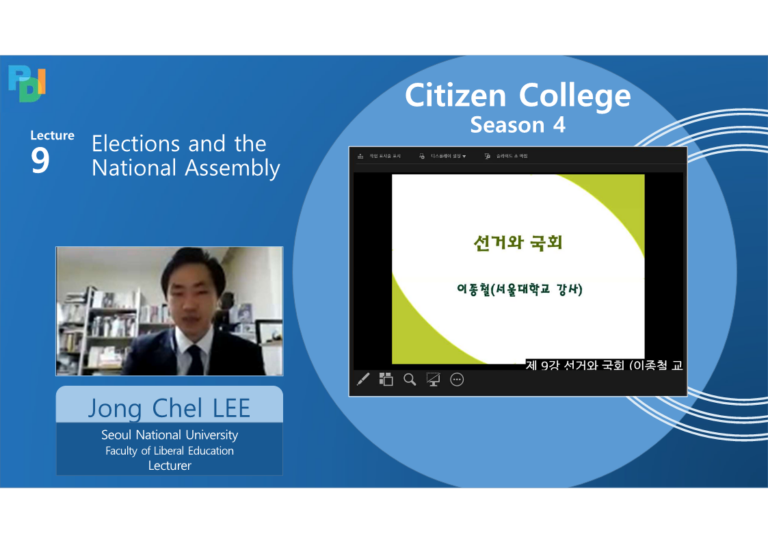
[Citizen College Season 4] #9 Elections and the National Assembly

2020.11.12

On November 12, 2020, the ninth lecture of Citizen College Season 4 < Citizen and Participation: How do citizens become owner of politics? > , co-hosted by the Seongbuk-gu Office and the Peace and Democracy Institute, was conducted using ZOOM. The ninth lecture was given by Dr. Jong Chel Lee from Seoul National University. The lecture titled “Elections and the National Assembly” was a time to look at the conflicts within the National Assembly regarding the changes in the electoral system and the reform of the electoral system in Korea. Highlighting the National Assembly’s recent large number of outstanding bills, we looked at the implications of reforming the electoral system to a linked proportional representation system in the name of advancing the National Assembly and the fast-track conflicts that have been implemented. The lecturer recounted the implications of the recent reform of the electoral system and the fast-track conflict, suggesting⋯

[Citizen College Season 4] #8 Elections and Authoritarianism

2020.11.06

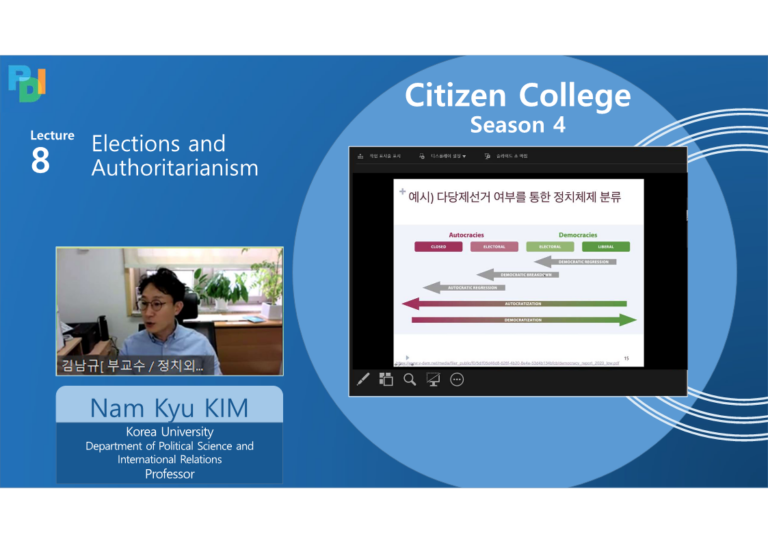
On November 6, 2020, the eighth lecture of Citizen College Season 4 < Citizen and Participation: How do citizens become owner of politics? > , co-hosted by the Seongbuk-gu Office and the Peace and Democracy Institute, was conducted using ZOOM. The sixth lecture was given by professor Nam Kyu KIM of the Department of Political Science and International Relations of Korea University. The lecture, titled “Elections and Authoritarianism,” examines various conditions for democracy and highlights that elements of democracy in general elections are also found in many authoritarian countries. Contrary to the general common sense that elections are the exclusive property of democracy, many dictators were adopting elections for reasons such as pressure from abroad, efforts by Western democracies to spread democracy, and overseas aid. In addition, elections within authoritarian regimes were used as a means to justify the regime, to recruit and reward local elites, to show off the power⋯

[Citizen College Season 4] #7 Elections and Party Politics

2020.11.05

On November 5, 2020, the seventh lecture of Citizen College Season 4 < Citizen and Participation: How do citizens become owner of politics? > , co-hosted by the Seongbuk-gu Office and the Peace and Democracy Institute, was conducted using ZOOM. The seventh lecture was given by professor Jai-Kwan JUNG of the Department of Political Science and International Relations of Korea University. The lecture titled “Elections and Party Politics” explores the function and meaning of political parties in representative democracy and the relationship between electoral institution and party systems. In representative democracy, the party plays a role in simplifying voters’ choice of candidates, encouraging political education and participation, selecting candidates to represent certain socioeconomic interests, and organizing government and implementing policies through election victory. And the differences in the electoral system led to different political parties in different countries, and affected the policy preferences of political parties within the election. The lecturer⋯

[Citizen College Season 4] #6 History of Election and Political Philosophy

2020.10.30

On October 30, 2020, the sixth lecture of Citizen College Season 4 < Citizen and Participation: How do citizens become owner of politics? > , co-hosted by the Seongbuk-gu Office and the Peace and Democracy Institute, was conducted using ZOOM. The sixth lecture was given by professor Hong-Kyu Park of the Department of Political Science and International Relations of Korea University. The lecture titled “The History of Elections and Political Philosophy” looked at the overall history of elections from the beginning to the crisis of representative democracy, and looked at the second-best and best ideas on representative democracy. Second-best practice has called for the expansion of direct democracy, emphasizing the crisis of the elite-oriented representative system, considering representative democracy as an incomplete replacement for direct democracy. On the other hand, the best policy is to regard representative democracy as a superior political system suitable for modern times, emphasizing the equality and⋯

[Citizen College Season 4] #5 Are Elections Democratic?

2020.10.29

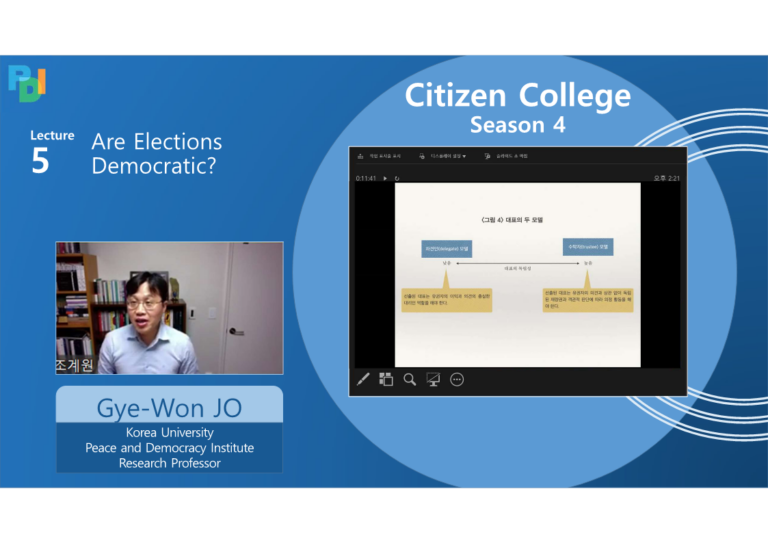
On October 29, 2020, the fifth lecture of Citizen College Season 4 < Citizen and Participation: How do citizens become owner of politics? > , co-hosted by the Seongbuk-gu Office and the Peace and Democracy Institute, was conducted using ZOOM. The fifth lecture was given by professor Gye-Won Jo of the the Department of Political Science and International Relations of Korea University. The lecture titled “Are Elections Democratic?” looked back at the first democracy in Athens and found that elections did not really represent democracy. In Athens, where the first democracy took place, unlike modern democracy, civil servants and governance organizations were elected by lottery, not by election. Through this, distance in direct democracy in Athens was very close than the representative system, and politics was very routine, and anyone could participate, not just a specific elite. Through this example of Athens democracy, the lecturer emphasized the meaning of the lottery in⋯

[Citizen College Season 4] #4 Elections and Election Management

2020.10.23

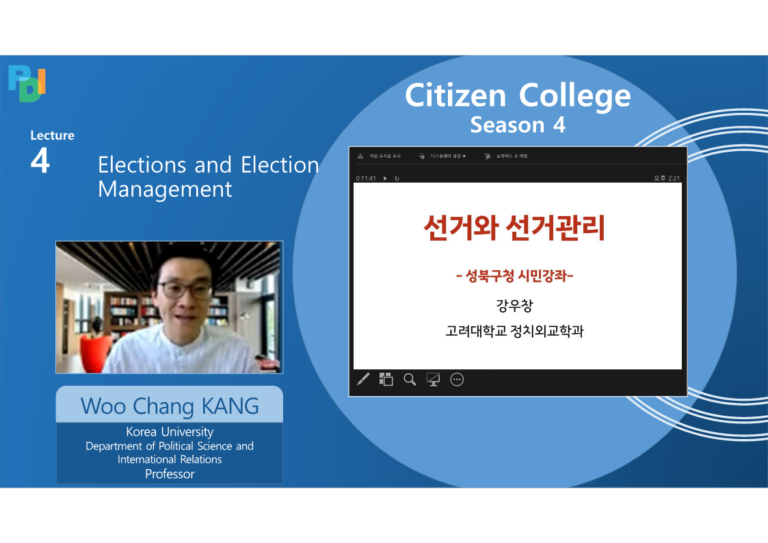
On October 23, 2020, the fourth lecture of Citizen College Season 4 < Citizen and Participation: How do citizens become owner of politics? > , co-hosted by the Seongbuk-gu Office and the Peace and Democracy Institute, was conducted using ZOOM. The fourth lecture was given by Professor Woo Chang Kang of the Department of Political Science and International Relations of Korea University. The lecture titled “Elections and Election Management” looked at the importance of election management, the role of the Election Commission, and the public’s perception of election management. Election management is necessary for fair and unconstrained elections, and the National Election Commission managed election management and played a role in supporting election expenses and election affairs. In particular, Korea’s election management emphasized fairness between the value of freedom and fairness, showing a regulatory stance on the management of election expenses. Professor Kang looked at the importance of election management and⋯

  • 이전
  • 1
  • 2
  • 3
  • 4
  • 5
  • 6
  • …
  • 9
  • 다음
(02841) PDI, Korea University, 145, Anam-ro, Seongbuk-gu, Seoul, Republic of Korea
  • Tel_ 82-2-3290-1644~5
  • Fax_ 82-2-925-3906
  • Email_ peacestudies@korea.ac.kr
Copyright © 2026 Peace & Democracy Institute all rights reserved.

Sign up for PDI newsletter