Skip to content

PDI Logo

  • About PDI
    • About Us
    • History
    • Vision and Mission
    • People
    • Contact
  • Centers
    • CISS
    • CSPL
    • CSEU
    • KACDC
    • CRCEA
    • CSC
    • CSID
  • Activities
    • Soodang/Woodang Colloquium
    • Woodang Academy
    • Jiam Research Workshop
    • Civic Education
    • Events
    • Pol in Love
  • Publications
    • Journal Article
    • Book
    • Working Paper
  • Journal
    • Peace & Democracy
    • About Peace Studies
    • Editorial Board
    • Archive
    • For Contributors
    • Submission
  • News
    • Notice
    • Upcoming Events
    • Press Release
    • Newsletter
Korean English
KOR ENG
  • About PDI
    • About Us
    • History
    • Vision and Mission
    • People
    • Contact
  • Centers
    • CISS
    • CSPL
    • CSEU
    • KACDC
    • CRCEA
    • CSC
    • CSID
  • Activities
    • Soodang/Woodang Colloquium
    • Woodang Academy
    • Jiam Research Workshop
    • Civic Education
    • Events
    • Pol in Love
  • Publications
    • Journal Article
    • Book
    • Working Paper
  • Journal
    • Peace & Democracy
    • About Peace Studies
    • Editorial Board
    • Archive
    • For Contributors
    • Submission
  • News
    • Notice
    • Upcoming Events
    • Press Release
    • Newsletter

Activities

  • Soodang/Woodang Colloquium
  • Woodang Academy
  • Jiam Research Workshop
  • Civic Education
  • Events
  • Pol in Love

Civic Education

[Citizen College] Challenges of International Situation and Korea’s Diplomacy and Security Strategy

Shin-wha Lee 2018.06.29

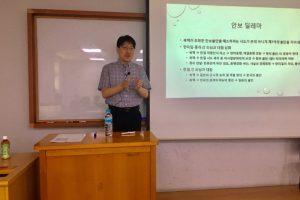
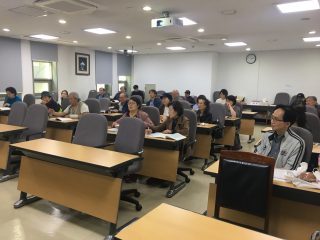
On June 29, 2018, the 11th lecture of “Citizen College: Citizens Between Life and Knowledge” was held by Seongbuk Village Citizenship Education Center and the Korea University Peace and Democracy Institute(PDI). The 11th speaker was Professor Shin-wha Lee of Korea University. The topic of the lecture was “Challenges of International Situation and Korea’s Diplomacy and Security Strategy”. The professor explained the changing international situation and the strategic choices of diplomacy and security in Korea. The first main point was changing the security concept. Traditional security means protecting the country from threats outside the border. In recent years, however, the importance of non-traditional security has increased. Unconventional security means security issues arising from diseases, starvation, and terrorism. The concept of security covering both traditional and non-traditional security is not comprehensive. Nowadays, the concept of security is extended not only to territorial and political security, but also to protect individuals and groups from⋯

[Citizen College] North Korea’s Nuclear Arms and International Relations in Northeast Asia

Dong Sun Lee 2018.06.22

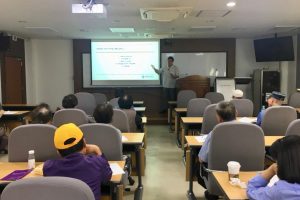
On June 22, 2018, the 10th lecture of “Citizen College: Citizens Between Life and Knowledge” was held by Seongbuk Village Citizenship Education Center and the Korea University Peace and Democracy Institute(PDI). The 10th speaker was Professor Dong Sun Lee of Korea University. The topic of the lecture was “North Korea’s Nuclear Arms and International Relations in Northeast Asia”. He critically analysed the hollow belief of making East-Asian Community through checking out many problems which arose from the relationship with neighboring countries due to North Korea’s nuclear development. A typical example of North Korea’s nuclear development is the illusion of a security dilemma, distrust caused by bubbles, and the New Cold War. North Korea’s nuclear arsenal has fostered a security dilemma among neighboring countries. The attempt to alleviate the security anxiety caused by the North Korean nuclear program has created an uneasy situation for third countries. In addition, North Korea’s nuclear development⋯

[Citizen College] Missile Politics on the Korean Peninsula

Jiil Kim 2018.06.15

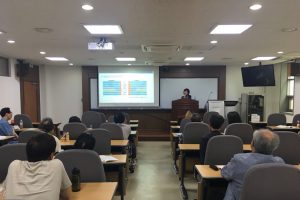
On June 15, 2018, the 9th lecture of “Citizen College: Citizens Between Life and Knowledge” was held by Seongbuk Village Citizenship Education Center and the Korea University Peace and Democracy Institute(PDI). The 9th speaker was Professor Jiil Kim of PDI. The theme of the lecture was “missile politics on the Korean Peninsula”. He examined the status of missile development on the Korean Peninsula and neighboring countries and suggested the form of defence that Korea should pursue. In the introduction, the lecturer found out the difference between the actors of domestic politics and the actors of international politics, and the importance of missiles in international politics. The missile, while being a conventional weapon, plays a role in maximizing strategic value by linking with nuclear weapons, and acts as a key to understanding the ‘intention of the state’ by stimulating sensitivity among countries. Also, he explained the deterrence theory that prevents the act⋯

[Citizen College] Child Poverty: Comparison between Korea and Japan

Insook Choi 2018.06.08

On June 8, 2018, the 8th lecture of “Citizen College: Citizens Between Life and Knowledge” was held by Seongbuk Village Citizenship Education Center and the Korea University Peace and Democracy Institute(PDI). The 8th speaker was Professor Insook Choi of PDI. The topic of the lecture was “Children’s Poverty: Comparison between Korea and Japan”. She examined child poverty, which is now a big problem in Japan, and compared it with the case in Korea. Japan’s child poverty rate has continued to rise, reaching 10% in 1985, and close to 16% in 2012. Reasons for such child poverty is the destruction of family function due to domestic violence and divorce, the change of the role concept of ‘parents’, and the destruction of the school due to extreme private tutoring. Korea has a lower rate of child poverty than Japan, but the relative poverty problem is serious, and the problem of child poverty has⋯

[Citizen College/Film Festival] Speaking of Democratizaion in South Korea

2018.06.04

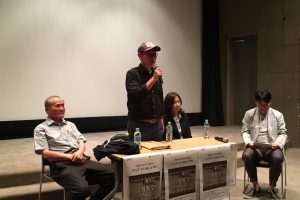
On June 4, Peace and Democracy Institue(PDI) held a film festival, looking back the meaning of ‘the June Struggle for Democracy’ and democratization at the KU Cinema Trap. After watching the movie <1987>, which was a story about people who lived in 1987, Director Jang Joon Hwan, Professor Eunju Chi, the citizen panel Kim Doek-bae and the audience shared the movie talk. It was an opportunity to think about what the ‘June Struggle for Democracy’ meant to them and what it left in Korean democracy. This event was planned as a part of the ‘Citizen College: <Citizens Between Life and Knowledge>’ which has been organized by PDI and Seongbuk Village Citizenship Education Center.

[Citizen College] Inequality, Identity and Political Generation: Taiwan’s Case

Eunju Chi 2018.06.01

On June 2, 2018, the 7th lecture of “Citizen College: Citizens Between Life and Knowledge” was held by Seongbuk Village Citizenship Education Center and the Korea University Peace and Democracy Institute(PDI). The 7th speaker was Professor Eunju Chi of PDI. The topic of the lecture was “Inequality, Identity, and Political Generation: Taiwan’s Case”. In the lecture, Professor examined the student movement in Taiwan, the result of the election by generation, and the national identity of the Taiwanese, and based on that, searched answer for the question “Why did the young generation in Taiwan recently increase their political participation?” The Taiwanese sunflower movement was a student movement that the Nationalist Party has declared “Cross-Strait trade agreement” with China. In addition, the recent election results showed that the 2-30s have a higher preference for the Democratic Progressive Party than the Nationalist Party of China. When we tracked the 20s’ adolescents period through the⋯

[Citizen College] Inequality and Poverty, and the Role of the State

Yangho Rhee 2018.05.25

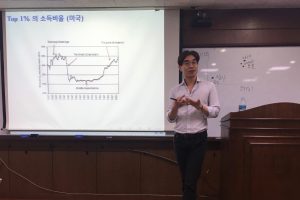
On May 25, 2018, the 6th lecture of “Citizen College: Citizens Between Life and Knowledge” was held by Seongbuk Village Citizenship Education Center and the Korea University Peace and Democracy Institute(PDI). The 6th speaker was Professor Yangho Rhee of PDI. The topic of the lecture was “Inequality, Poverty and the Role of the State.” It was time to look at the phenomenon of inequality and poverty, which is becoming more severe in modern society, and to think about the role of the state about it. Firstly Professor showed how to calculate inequality and income disparity through the Gini coefficient, Palma ratio, and Piketty’s income inequality model. As a result, he said that about 1% of the world’s population has more wealth than the rest 99%. This wealth is inherited among the generations, and the inequality between the generations is becoming more and more fixed. Unlike the rich, the poor have “poverty culture,”⋯

[Citizen College] Inequality, Welfare State, and Happiness

Hyeok Yong Kwon 2018.05.18

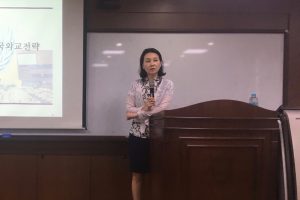
On May 18, 2018, the 5th lecture of “Citizen College: Citizens Between Life and Knowledge” was held by Seongbuk Village Citizenship Education Center and the Korea University Peace and Democracy Institute(PDI). The 5th speaker was Professor Hyeok Yong Kwon of Political Science & International Relations Department, Korea University. The topic of the lecture is “Inequality, Welfare State, and Happiness.” Professor examined how inequalities in political, economic and social factors affect individual happiness and what kind of welfare state is being addressed as a solution to this problem. He told that Inequalities include both income inequality and inequality in opportunity, and the controversy about the ‘gold spoon’ and the ‘dirt spoon’ in Korean society shows that the inequality of opportunity in Korean society is serious. Income inequality can also lead to unequal democracy because the ruling parties and governments are more responsive to the preferences of high-income earners. On the other hand,⋯

[Citizen College] Conflict Management Leadership in Crisis Situations

Moon Hee Song 2018.05.11

On May 11, 2018, the 4th lecture of “Citizen College: Citizens Between Life and Knowledge” was held by Seongbuk Village Citizenship Education Center and the Korea University Peace and Democracy Institute(PDI). The 4th speaker was Professor Moon Hee Song of PDI. The topic of the lecture was “Conflict Management Leadership in Crisis Situations” and she showed that the leadership of authentic communication is important to overcome the crisis situations that are common in modern society. There have been many examples of crisis situations, such as the domino pizza incident, the Mauna Ocean Resort collapse, and the September 11th incident. Especially in the 9/11 crisis, the US Federal Bureau of Crisis Management became the control tower of the crisis management and all cities in New York City communicated and cooperated. Examples of cases where the crisis situation is not well managed include the disasters of Seowol Ferry, the comfort women issue between⋯

[Citizen College] The Righteousness of Democracy: The Perils of Excessive Moralism

Doo-Jin Kim 2018.05.04

On May 4, 2018, the 3rd lecture of “Citizen College: Citizens Between Life and Knowledge” was held by Seongbuk Village Citizenship Education Center and the Korea University Peace and Democracy Institute(PDI). The 3rd speaker was Professor Doo-Jin Kim of PDI. The topic of the lecture was “the righteousness of democracy: the perils of excessive moralism”. Professor argued that applying excessive moral standards, in terms of democracy, poses a risk of falling into moralism. We often place democracy and justice on the same line with each other, but in fact, democracy is not a just form of justice. Citizens of democracy are not that moral individual. In the democracy, when citizens demand complete justice, politicians are provocative to populism and society is divided. For example, the German Nazism conducted Jewish massacre, as the result of “social justice” to preserve the superiority of the Aryans. Even though individuals are not so justified as to⋯

  • 이전
  • 1
  • …
  • 6
  • 7
  • 8
  • 9
  • 다음
(02841) PDI, Korea University, 145, Anam-ro, Seongbuk-gu, Seoul, Republic of Korea
  • Tel_ 82-2-3290-1644~5
  • Fax_ 82-2-925-3906
  • Email_ peacestudies@korea.ac.kr
Copyright © 2026 Peace & Democracy Institute all rights reserved.

Sign up for PDI newsletter